MCP × SecOps: Wiring 30+ Security Tools into One AI-Powered Nerve Centre

Sentinel for logs. GreyNoise for IP rep. GHAS for code findings. Prowler for cloud posture. Okta for identity. Vault for secrets. Jira for tickets. Slack for "hey did anyone see this alert." Ten dashboards. Ten query languages. One analyst alt-tabbing through all of them like a DJ mixing tracks — except nobody's dancing and the alert queue keeps growing.
Over the last few posts I've been stitching together a DevSecOps pipeline that blocks bad code at the PR, wiring GHAS into a three-layer security gate, and funnelling everything into DefectDojo so findings don't scatter across five dashboards. Good progress — but there's a bottleneck I haven't touched: the human is still the integration bus. An analyst spots a Dependabot critical, pivots to GreyNoise to check exploitation status, cross-references OpenCTI for threat actor context, swivels to Okta for session data, then manually types a Jira ticket and drops a Slack update. That's not orchestration. That's a biological SOAR with a coffee dependency.
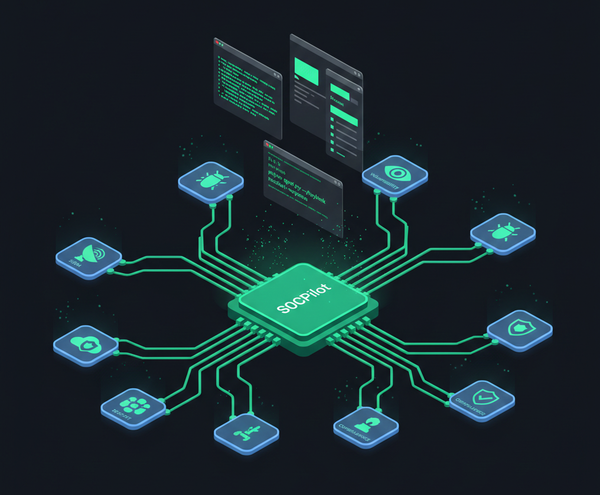
MCP — Model Context Protocol — changes the wiring. It's an open standard (think JSON-RPC over stdio/SSE) that lets AI agents call into external tools through a unified interface. One protocol, any tool. And in 2025-26 the security vendor ecosystem went all-in: Sentinel, Splunk, Elastic, GreyNoise, Semgrep, Snyk, Vault, Okta, Cloudflare, Drata — all shipping MCP servers. Suddenly your AI co-pilot isn't just a chatbot. It's a SOC multiplier with read access to your entire security stack and the ability to correlate across tools in seconds, not hours.
What That Looks Like in Practice
Instead of logging into Sentinel, writing KQL, copying the results, pasting into a Jira ticket, and posting to Slack — you tell your AI co-pilot:
"Sentinel alert SEC-7721. Impossible travel for admin@company.com. Pull the full event, check the source IP on GreyNoise, see if OpenCTI has threat actor matches, check their Okta sessions, and create a P1 Jira ticket with the full timeline."
One prompt. Five MCP tool calls. Thirty seconds. Zero tab-switching.
The Ecosystem: What's Actually Available
The MCP security ecosystem has exploded. Here's what's production-ready today, organised by what a SOC actually needs:
┌─────────────────────────────────────────────────────────────┐
│                    AI Security Co-pilot                      │
│          (Any MCP-Compatible AI Client / Agent)              │
└──────────────────────────┬──────────────────────────────────┘
                           │ MCP Protocol (JSON-RPC)
        ┌──────────────────┼──────────────────────┐
        ▼                  ▼                      ▼
┌──────────────┐  ┌───────────────┐  ┌───────────────────┐
│   DETECT     │  │   INVESTIGATE │  │     RESPOND       │
├──────────────┤  ├───────────────┤  ├───────────────────┤
│ Semgrep      │  │ Sentinel      │  │ Jira/Linear       │
│ Snyk         │  │ Splunk        │  │ Slack/PagerDuty   │
│ Trivy        │  │ Elastic       │  │ Okta              │
│ GHAS         │  │ GreyNoise     │  │ Vault (rotation)  │
│ Prowler      │  │ OpenCTI       │  │ Cloudflare WAF    │
│ StackHawk    │  │ Vault Radar   │  │ GitHub (PRs)      │
│ Burp Suite   │  │ Datadog       │  │ Drata/Vanta       │
│ Nuclei       │  │ Detections DB │  │                   │
└──────────────┘  └───────────────┘  └───────────────────┘
SIEM & Monitoring
Microsoft Sentinel has an official MCP server that lets you run KQL queries, manage incidents, and review analytics rules — all from natural language. Instead of writing SecurityEvent | where TimeGenerated > ago(1h) | where EventID == 4625, you say "show me failed logins in the last hour" and the AI translates, executes, and summarises.
Splunk ships a Technology Add-On for MCP that parses JSON-RPC output and integrates with existing SIEM workflows. Elastic has its Agent Builder MCP (requires 9.2+). Datadog covers metrics, logs, and incident RCA. Pick whichever SIEM you already run — chances are it has an MCP server now.
Vulnerability Scanning
Semgrep (official MCP), Snyk (official), Trivy (official, zero-auth), GHAS (community with official backing), and StackHawk (official DAST). The pattern here is read-only access to findings — your AI pulls alerts, correlates across scanners, and surfaces what actually matters.
The killer combination: GHAS for Dependabot alerts + Snyk for reachability analysis + GreyNoise for exploitation status. A critical CVE that's not reachable in your code and not being actively exploited is very different from one that is both.
Threat Intelligence
GreyNoise (official) tells you whether an attacking IP is a mass scanner or a targeted threat. OpenCTI (community, self-hosted) gives you threat actor attribution, IOC correlation, and MITRE ATT&CK mappings. VirusTotal (community) handles file and URL reputation. Together, they turn raw alerts into contextualised intelligence.
Cloud Security & Compliance
Prowler scans AWS/Azure/GCP against CIS, SOC 2, PCI-DSS, and more. Cloudflare gives you WAF events, Zero Trust policy management, and even an AI firewall that detects prompt injection. Drata and Vanta expose compliance framework status so you can ask "how's our SOC 2 readiness?" and get an actual answer.
Secrets & Identity
HashiCorp Vault (official) for credential rotation. Vault Radar (official) for leaked secret detection. Okta (official) for user identity, session management, and access review. These three together handle the entire secret leak lifecycle: detect → scope → rotate → disable sessions → document.
Detection Engineering
Security Detections MCP aggregates Sigma, Splunk ESCU, Elastic, and KQL detection rules into a searchable database. Zero auth, runs locally, completely offline. Ask "do we have detection rules for T1059.001?" and get matching Sigma rules translated to your SIEM's query language.
Six Use Cases That Change How a SOC Operates
1. Vulnerability Triage (SOC L1/L2)
Before MCP: Analyst sees Dependabot alert → opens GHAS → reads CVE details → opens NVD → checks if patch exists → opens GreyNoise manually → opens Jira → types ticket → posts to Slack. Fifteen minutes per alert. Fifty alerts per day.
With MCP: "New critical Dependabot alert for CVE-2024-50623 in payments-api. Run the full triage playbook."
AI: [Queries GHAS] → Cleo Harmony RCE, affects file upload module
    [Queries GreyNoise] → Active mass exploitation, 2,400+ IPs
    [Queries OpenCTI] → Linked to Cl0p ransomware campaigns
    [Queries Snyk] → Direct dependency, reachable code path
    [Queries Detections] → 3 Sigma rules available

    Verdict: P1 — IMMEDIATE. Active exploitation, reachable.
    [Creates Jira P1 ticket with full context]
    [Posts to #vuln-triage in Slack]
Thirty seconds. Same quality. The analyst reviews and approves instead of doing the legwork.
2. Incident Response (SOC L2/L3)
The incident response workflow is where MCP shines brightest. A single prompt can orchestrate the entire OODA loop — observe, orient, decide, act:
"Sentinel alert: impossible travel for admin@company.com.
 Login from US then Nigeria in 3 minutes."

AI: [Sentinel] → Nigeria session downloaded 47 SharePoint files
    [GreyNoise] → IP: residential ISP, first seen today, suspicious
    [OpenCTI] → IP range linked to BEC campaigns targeting O365
    [Okta] → MFA via push notification (MFA fatigue?), member of
             Global Admins + Finance-Approvers
    [Vault Radar] → User committed AWS key 2 weeks ago (rotated)

    VERDICT: P1 — Confirmed compromise via MFA fatigue.

    RECOMMENDED CONTAINMENT (awaiting your approval):
    1. Okta: Terminate all sessions
    2. Okta: Force MFA re-enrollment (hardware key)
    3. Vault: Rotate accessible secrets
    4. Cloudflare: Block attacker IP range
The AI doesn't execute containment automatically — it presents the plan and waits for human approval. That's the right pattern. AI does the correlation and preparation; humans make the call.
3. Threat Hunting
Instead of manually searching for Sigma rules, translating them to KQL, and running queries:
"Hunt for Volt Typhoon TTPs — T1059.001 (PowerShell), T1053.005 (Scheduled Tasks), T1003.001 (LSASS dumping) — across the last 90 days."
The AI finds matching detection rules, translates to your SIEM's query language, runs the hunts, enriches results via threat intel, and produces a prioritised findings report. A threat hunt that used to take a day takes an hour.
4. Compliance Audit
"SOC 2 audit in 6 weeks. Run full readiness — AWS posture, code security, and Vanta status."
AI runs Prowler (cloud), checks GHAS (code), queries Vanta (framework), cross-references findings against controls, and produces a gap report with remediation priorities. The GRC team gets a structured assessment instead of three separate dashboards.
5. Secret Leak Response
Leaked credential detected → AI traces exposure scope (how many repos? CI logs? Wiki pages?) → determines blast radius (what can this key access?) → rotates the credential → checks audit logs for misuse → creates incident ticket → notifies the team. The entire lifecycle, orchestrated through MCPs, with human approval for destructive actions.
6. Cloud Security Posture Review
Monthly cloud posture review becomes a conversation: "How's our AWS security compared to last month?" The AI runs Prowler checks, compares with previous results, correlates with Cloudflare WAF events, identifies regressions, and highlights quick wins — all in one response.
The Architecture
How MCP Actually Works
┌───────────────┐                    ┌───────────────────┐
│   AI Client   │                    │   MCP Server      │
│  (AI Agent)   │                    │   (e.g. Sentinel) │
│               │   ── initialize ──▶│                   │
│  AI discovers │   ◀── tools[] ──── │  Declares tools   │
│  available    │                    │                   │
│  capabilities │   ── tools/call ──▶│  Executes query   │
│               │   ◀── result ───── │  Returns data     │
└───────────────┘                    └───────────────────┘
Each MCP server declares what it can do (tools), what data it can provide (resources), and what workflow templates it supports (prompts). The AI client discovers these capabilities at startup and decides which tools to use based on your request.
The transport is either stdio (local, most secure) or SSE (remote, for cloud-hosted MCPs). For security tools, stdio is preferred — your credentials and data stay on your machine.
Deployment Tiers
You don't need all 30+ tools. Start with what you have:
Tier 1 — Solo Analyst (Free): GHAS + Semgrep + GreyNoise (community) + Security Detections. Zero cost. Covers vulnerability triage and basic threat intel.
Tier 2 — Team SOC: Add Sentinel/Splunk + Prowler + Vault + Jira + Slack. Covers full incident response, cloud posture, and credential rotation.
Tier 3 — Enterprise: Add OpenCTI + Drata/Vanta + Okta + Cloudflare + StackHawk + Datadog. Full compliance automation, identity-aware response, and DAST coverage. Consider an MCP Gateway (like Cloudflare Zero Trust MCP Portals) for centralised auth and audit logging.
Security Considerations (Yes, There Are Some)
Connecting AI to security tools is powerful. It's also a risk surface. A few things to get right:
Authentication: 53% of MCP servers today use static API keys. That's not great. Push for OAuth 2.1 where supported (Okta, Cloudflare, Atlassian, Vanta). Use HashiCorp Vault to store and rotate all other credentials. Never hardcode anything.
Prompt injection: MCP data is untrusted input. A malicious commit message could contain instructions that manipulate AI analysis. A crafted alert description could include injection payloads. The mitigation: treat AI output as advisory, not authoritative. Human review before destructive actions. Always.
Least privilege: Each MCP server gets its own scoped token. Sentinel gets read-only Log Analytics access. GHAS gets read-only security_events. Vault gets a policy scoped to specific secret paths. Okta gets read-only unless you explicitly need session management.
Audit trail: Log every MCP tool invocation to your SIEM. Who asked what, when, and what data came back. Create detection rules for anomalous patterns — bulk data queries at 3 AM, credential rotation without a preceding incident, cross-tool queries suggesting data exfiltration.
Network isolation: Run MCP servers in containers with restricted egress. Each server should only be able to reach the API it's configured for. Nothing else.
The Repo
I've published a complete reference implementation: mcp-security-ops-suite.
What's inside:
- Ready-to-use MCP configs for 20+ security tools, organised by category (SIEM, vuln scanning, threat intel, cloud, secrets, compliance, identity, detection, ticketing)
- Six SOC playbooks with exact prompts for vulnerability triage, incident response, threat hunting, compliance audit, secret leak response, and cloud posture review
- Reference architecture with data flow diagrams for each use case
- Security guide covering auth, prompt injection, least privilege, audit trails, and network isolation
mcp_config.json— drop-in config with all 20+ MCP servers pre-configured- Setup scripts for environment configuration and config validation
Start with Tier 1 (free), validate the workflow with your team, then expand.
What This Isn't
This isn't a replacement for your SOC platform. It's not a SOAR. It's not going to run your incident response while you sleep.
What it does is eliminate the dumb work — the tab-switching, the copy-pasting, the "let me check another dashboard" — so your analysts can focus on the decisions that actually require a human brain. The AI does the correlation and preparation. The human does the judgment and approval.
That's the right division of labour. And with 30+ security tools now speaking MCP, it's actually practical today — not a roadmap slide.
What's Next
The MCP security ecosystem is moving fast. A few things to watch:
- MCP Gateways like Cloudflare's Zero Trust MCP Portals are adding enterprise-grade auth, audit logging, and rate limiting around MCP servers
- OAuth 2.1 adoption is still at ~8% but growing — push your vendors
- Multi-agent workflows where specialised security agents (vuln triage agent, IR agent, compliance agent) coordinate through MCP
- Detection-as-code for MCP — Sigma rules that detect anomalous MCP usage patterns
The security industry spent a decade building best-of-breed point solutions. MCP might be what finally connects them.
Resources
- MCP Specification (2025-11-25) — The protocol standard
- Official MCP Server Registry — Find MCP servers
- MCP Security Ops Suite (GitHub) — This project
- OWASP MCP Top 10 — Security risks in MCP
- PulseMCP Directory — 8,000+ MCP servers, filterable
- GreyNoise MCP — Threat intel MCP
- Security Detections MCP — Sigma/ESCU rule database
- HashiCorp Vault MCP — Secret management
- Cloudflare MCP Portals — Zero Trust for MCP